Showing posts with label Courage. Show all posts

November 12, 2016

Toxic Man

Back in the heyday of this blog it was a regular feature of mine to denounce macho misogynist nonsense and to champion feminism. I didn't leave it off because I thought everything was fixed; far from it. But there were signs of hope.

The twitter storm of misogyny that surrounded campaigns to get women on banknotes, for example, did not get in the way of success. I tried, as best as I could, to see such public hate as representative of the death throes of a soon to be extinct monster. Toxic man had been given license, through social media, to be the loudest empty vessel. But there was much more reason to be optimistic in my variety of metropolitan bubbles than there were reasons to be pessimistic. Among men in my world, to champion feminism had become a commonplace. When Canada bucked the trend last year and lurched left, those who value equality of treatment and opportunity welcomed what looked like a substantial breakthrough: a male leader who called himself a feminist, sounded like he knew what he meant by it, and called on parents to educate their sons on the matter. I thought a corner had been turned. Looks like I was wrong.
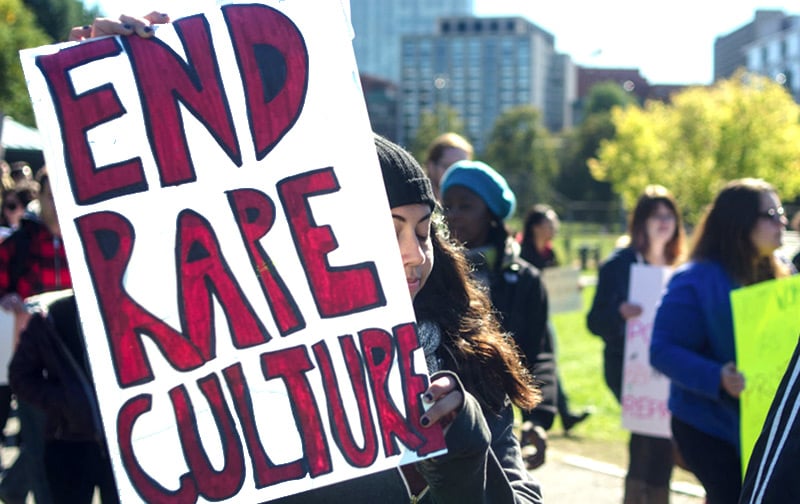
Image result for rape culture

The alarming shift to the right in polities across the world has opened up a crack where toxic man's confidence grows like black mould in the dank locker room at the end of the world. Emboldened by irresponsible hate speech and rape speech, by the utterances of men in positions of power, the lecherous mob has seen fit to step into the light. The largely white masculine TV news media (especially in the US) will not sufficiently condemn it. They have helped create it, after all.

It is not and never has been manly to lord a superiority complex over women and in fact bespeaks cowardice, want of feeling, brainlessness and a deeply warped view of the world. Men who embrace sexual predation, the objectification of women's bodies, and the diminution of women's minds, are not worthy of a place in our societies, let alone a place of leadership. They are not powerful, but they are dangerous. Their credo is violence. When they brazenly occupy not only the social ether but also the streets, becoming a tangible physical and sexual threat, they deserve more than our contempt and condemnation. Step up! If you see something, intervene. Don't stand idly by. Call the police. Now is not the time to be a mouse.

March 13, 2011

Sporting Courage

It occurred to me that I really ought to let the North American continent know the nature of that which I blather on about so much. Just why does cricket exemplify manliness to such a great extent?


Here’s some footage of Brian Close in 1976 facing the bowling of Michael Holding of the West Indies. It was in the days before helmets, arm guards, thigh pads, and chest guards. This was maybe the most vicious spell of bowling the world had seen, and what does Close do when the ball hits him? Chews his gum. At no point would showing the bowler his pain have helped his plight, for the bowler would have thrived on seeing the batsman’s anguish. The balls that hit Close were pretty nasty, but more impressive is Close’s technique at getting out of the way of the ones that didn’t hit him. At least two in this over were likely to have killed him, but the slow motion shows just how closely he watched the ball.


Arguably, the technique of contemporary batsmen has declined because of the advent of the helmet. This ball ended up giving Australian captain Ricky Ponting a nasty scar, but without the face grille it would have demolished his cheek bone.


Next, a famous encounter between England’s Michael Atherton and South Africa’s Allan Donald. One youtube user described this sequence as ‘unstoppable force against immovable object’, which to me seems quite apt. If any of you find yourself wanting for interpersonal psychology in sport, have a look at these two staring each other down and fill your boots. Also note the way Athers keeps his wrists down and his bat out of the way. His body control was pretty exquisite.


In case you were wondering, cricket balls are significantly harder than baseballs and, in all these instances, are being delivered at something around 90 miles per hour. In Holding’s case it was probably faster.

And then there’s the fact that cricketers catch that hard ball without the need of big bucket-like gloves. Take a look:


And what happens when something goes awry and a guy does get hurt? Shoaib Akhtar did his best to take Brian Lara’s head off, but he was pretty horrified to nearly succeed. See how competitiveness immediately transfigures into concern. Cricket is tough, but it is played in the right spirit.

February 17, 2011

On Civic Courage, Pushing, and The King's Speech

The German crowd positively thronged. In front of one door, the circus of lights and cameras suggested the peculiar lack of action that is Hollywood glam on the red carpet. The crowd here did not have tickets, but thirsted after a view of celebrity in the flesh. In front of the other door, a more sober crowd hunched its shoulders against the cold, gritted its teeth, and – after a Teutonic fashion – bayed for bread. Its nourishment of choice took the form of a good seat in the Friedrichstadtpalast so as to be better able to see the film in question. It was an avoidable mob. If only the organisers of the Berlinale (hailed as the people’s film festival) had bothered to assign seating, all the unpleasantness could have been avoided. As it was, the doors opened and the crowd charged. Old ladies stumbled in the stampede, and were trampled upon by other old ladies who had greater reserves of strength. It was as if Ryan Air had bought one of those new, super-large airbuses and had organised a free-for-all.


The film the crowd maddened to see was, funnily enough, about finding the courage to stand up for civilisation. Apparently, that’s the kind of thing people will risk their necks (or the necks of others) to see. Once seated, of course, the mob transformed into an entirely different animal: sober, respectful, and splendidly quiet. I’m no closer to understanding any of this than I ever was, but one cannot review a film, it seems to me, without reviewing the experience of seeing the film, of which all this is part and parcel.

Mrs. VB was sagacious enough to acquire for us two tickets to the gala opening of The King’s Speech, which was dutifully attended by Mr. Firth, Ms. Bonham-Carter, and Mr. Hooper. With the exception of Timothy Spall’s overly caricatured figure of Winston Churchill I thought the film absolutely splendid. There was some playing fast and loose with history, but such are films. In essence, the characters were well demarcated according to character, and overall George VI (Firth) represented an excellent example of civic courage, ably assisted by a stark contrast to the feckless and dishonourable Edward VIII (Guy Pearce), who demonstrated the timeless truth that clothes do not make the man.


I'm no paparazzo, but I stooped to snap this one

Packaged with considerable humour, the film depicts the struggle of a man to overcome all-too-human fears in order that he may perform sovereign duties. Those duties, as it transpires, were slight: mere reading, in fact. He neither had to think up, nor write his speeches. The sentiments were not his own, or at least did not have to be. He did not need to believe what he said, and he did not need to act upon what he said. But he had to talk of defeating the principle of might over right, and to rouse the real courage of those who would defeat it; he had to be believed, for people follow what they perceive to be the example of their leaders. The King’s stammer, a product of fear, would not embolden a nation, but make it hesitate on the trigger. The stammer had to go; the depths of personal misery and a history of abuse had to be plumbed; a speaker to be believed in had to be fashioned.

Twice in the film, the man who would rather not have been king was described as ‘the bravest man I know’. On both occasions I thought the speaker could not have known many men. But then, it takes a special kind of bravery to lead when you would rather follow; to honour duty when it falls on you against your will; to represent steadfastness when what you feel is weakness. Here was a man whose position meant he could not fight (although he once fought); a man who could barely string together a sentence; and a man who feared the life that birth and happenstance had dealt him. And despite these things, here was a man who had to make others believe that they could fight, and fight for him, for he embodied them as a sovereign nation.


How pleasant to see a king made humble but not left humble, as is the wont of the modern media. We are left with an image of a hero, a leader, a true king. We are confronted with circumstances that we, as ordinary men, will never face; but we see this man facing them and we admire his spirit. He becomes an aspirational figure, and garners our respect, and more importantly, our allegiance.

The audience laughed. The audience spontaneously erupted in bursts of applause during the film. The audience embraced the film’s vision of civilisation and its defenders. And then the audience stood up and pushed its way out onto the street.

January 26, 2011

Working Lunch; Or, Where There’s A Will There’s A Way

A kindly American professor once told me over lunch of his struggles through the system, finally to reach a place of security, contentment, and intellectual fulfilment. Having escaped the Eastern Bloc when a youngster, he had sought enrichment – of the mind, principally – in America. He found the going hard; money difficult to come by; basic expectations unexplained (for we tend not to explain to outsiders that which is normal to us). He set his sights on becoming a professor, making a promise to himself not to sell out to the first offer, but to cultivate his mind even if it meant going hungry. He had constructed for himself an end. As for the means, he was open to anything. A year without pay, but in the right academic environment, ultimately paid off. Encountering the best minds of his generation, he conquered his intellectual fears, and thereafter soared.


We live in difficult times, but then, everyone has always said such things. At times the things we want to do seem improbable, if not impossible. The temptation is to give in, let it go, raise the white flag. But let us wax Churchillian for a moment and consider the merits of declaring, ‘we shall never surrender’. Giving up and giving in to fear are much the same, and we are the worse for capitulation. Lying down to be walked upon, the invited footprints will slowly bruise the spirit and crush the soul. That job you are chasing; that girl, or boy; the feelings of security and contentment, for us and for our families; the escape from boredom: these are wants with which most of us can identify. They are worthy pursuits. A level higher, our ways of life; our freedom, to speak and to act; and our beliefs: these things we may not think about so directly, but they are given tangible form in the material and emotional desires of the former list. To give up on the one set because they are too hard or too expensive, the process too fearful, or too risky, is to jeopardize the latter. To give up is to let down the guard of vigilance that is the basis of freedom. When we give in to fear we are weak; when we are weak we are vulnerable; and when we are vulnerable the strong will smash us. It is precisely when we sense our weakness that we should muster courage. This is virtue. It is fortitude in the face of our own perceived limitations, or at the risk of our bodies and minds.

Another way of saying this is ‘where there’s a will there’s a way’. The will, much less the phrase, does not ward off failure. Rather, it suggests that failure should not be an act of volition. Moreover, the way is often not the along the intended route, but we might well resolve that come hell or high water we shall get where we are going in any case. The important part is not to resign before material difficulties. If our object is realistic, our nerve should hold steady. We may not be able to conjure up a job that isn’t there, or persuade a love that doesn’t care. But should the job, or the love, come along, we shall not have ourselves to blame if we do not prevail.

January 24, 2011

Corporate Man

Apparently if you work for Swiss bank UBS you’re about to get a break. Not the usual bonus, mind you, but a loosening of the corporate leash. I read in the news that UBS has a 44-page handbook telling its employees how to be – everything from their general appearance to their underwear and diet – and that this handbook is being revised and relaxed. As things stand, women aren’t supposed to wear red underwear (rather, it must be flesh toned), and garlic and onions are to be avoided. They’re instructed on their make-up, stockings and perfume to boot, with lifestyle tips for how to recover from wardrobe malfunctions. Men, for their part, undergo the same culinary prescriptions, as well as being told how to knot ties, to get regular haircuts, and to avoid unruliness in the piercing department (at this I am baffled. Is any amount of piercing on a man good?). Everyone is reminded to keep their glasses clean and shiny, lest they look negligent; but given the overbearing nature of the employer I wonder why they ever hire anybody with less than 20/20. ‘Our bankers can really see’ might be a unique selling point in this day and age.


All of this is nonsense, of course, and knowing the Swiss as I do I’m sure they take it all in the right spirit, which is to say, I’m sure they completely ignore it. Still, I’m given to wonder about what it takes to survive the cut and thrust of corporate land, so I’ve plundered the self-help shelves, subsection ‘executives’. There’s not much for men here, at least, not explicitly. There’s plenty of stuff for women though. Apparently, ‘a profound fear’ has ‘bound... women together over the course of the last 2000 years and continues to bind [them] together’. It is ‘the existential primal fear of sanctions and punishment’, associated with transgressing the role of ‘the unassuming, good little girl’ (Buholzer, Frauen starten durch, 1999). Another guide suggests that the ‘thing that stands between many women and the ability to get what they want is a proclivity toward self-denial… a preference for powerlessness’ (Rubin, The Princessa: Machievelli for Women, 1997). Meanwhile Corporate Man is everything Corporate Woman is not: he regards ‘new things as a challenge, and [is] usually of the opinion that accepting challenges is part of the essence of being a man’. Men are ‘primarily concentrated on themselves’; women are ‘afraid of exposing themselves to criticism’ (Haen, Das Zicken-Prinzip, 2000).* Which is to say, men should take a pill, and women should get over themselves. And all of this is sheer drivel.

Self-help?

The problem with self-help as a genre is that it is full of generalisations that, as an academic, I would immediately cross through in red ink if written by a student. The other problem with self-help as a genre is that it is not really self-help at all, but the preachings of self-assumed authorities. People who blindly follow its advices are no more asserting themselves than the rats who followed the piper out of Hamelin. The corporate idea that men are thus (sharks perhaps) and women thus (more like dolphins, if you were to believe Dodo Lazarowicz (Erfolg steht mir gut, 1999)), is not a foundation upon which the bonds of gender stereotypes can be broken, any more than Corporate Woman will be assisted by being given permission by the bank to wear red panties. Corporate World has gone through a crisis of late, and its population has shown itself to have lacked presence of mind, or the individual verve to think creatively around a problem. Corporate Man has shown himself to be afraid, like a little boy, of dealing with the enormity of new challenges, and, like so many lemmings, one by one they have walked over the cliff.


In sum, Corporate Man and Corporate Woman need be no different to any other man or woman of distinction in his/her character and general comportment. The uniform, such as it is, will merely give impetus to an attitude, but it will not by itself finish the cutting of jibs. In Corporate World there is more fear now than in living memory, but nobody, after all, is fearing for his life. It is a test of mere civic virtue to overcome it, and, on recent evidence, this is just as much of a challenge for Corporate Man as for Corporate Woman.

*Translations by Ulrich Bröckling, from ‘Gendering the Enterprising Self’, Distinktion (2005).

December 30, 2010

Manliness Throughout the Year

When I began this blog a little more than a year ago I had been thinking of what to do in defiance of the personal awfulness of 2009. As 2010 draws to a close, leading me to reflect that this year has – I can scarcely credit it – been worse, I am given to reassess what I am doing, and what purpose these humble pages serve, for you and for me. I am much more qualified to judge the importance of this outlet for me than for you, so perhaps you’ll let me know. But just in case anybody is holding his/her breath, let me reassure you that I am set to continue on the path I have cut.

I have reflected a number of times that manliness is tested in the fires of adversity. It’s easy to cut a suave figure of chivalrous demeanour on a flat-calm millpond; it’s how we grit our teeth in the face of an angry sea that really counts. Those calm moments are so much the more convincing if you can still do it once you’ve emerged from a storm. Manly strength, as I’ve opined so many times, has very little to do with outward force and a great deal to do with inner fortitude. What is your tolerance for emotional turmoil, career failure, domestic upheaval, knocks to the confidence, and challenges to your integrity? To what degree can you avoid wandering down paths of little resistance that will compromise your honesty and/or your conscience? How firm is your grip on your identity – are you sure that you should be who you purport to be, or who you desire to be? Isn’t it easier just to give up and go with the flow? To be swept out with the tide and stop resisting the inevitability of fate?


Well, it would be easier, yes, but it wouldn’t be right. And fate is just a poor man’s excuse for his own weakness. If I was defiant a year ago, I see no good reason to be less defiant now. When I sit down to compose the words that fill this site, I am connected with the ideals I set for myself, and with the principles I would be loath to see compromised. Looking over some of the things I have written, I am reminded of the moments of turmoil that I choose not to share with you – for why should you be troubled with them? – and I see that this is my way of remaining resolute. When knocked down, this is how I pick myself up. I am continually reinforcing the hull of my little craft, and let waves of any magnitude come, I shall not be scuppered. If you believe in a thing, you must believe in it most when it seems least likely.

If, along the way, any of this resonates with you good people, so much the better. Here’s to another year of Being Manly, and let’s raise a glass to 2011, whatever she may bring.

December 08, 2010

Man of the Year, 2010

The calendar is close enough to its terminal date to make the announcement of the first annual Being Manly Man of the Year. The decision process has been entirely personal and wholly undemocratic, but still it is more reliable than FIFA. The award, which conveys as much honour as its recipient would care to mention, comes with no formal prize. Nevertheless, the winner’s name will adorn this website for as long as it lasts, and I trust that the links to his endeavours will do him, and his causes, some good.

So, without further ado, the Being Manly Man of the Year is Australia’s own crazy runner, Tristan Miller, or ‘T-Bone’, if you will. Mr. Miller was implicitly introduced to you back in September, after I had met him on the Montreal Marathon course. I have followed his exploits on an almost daily basis since then, and can safely say that his is a rare spirit. A man of character if ever there was one, Mr. Miller is, at this moment, on the southern tip of Chile, preparing for a flight to Antarctica to run his 51st marathon this year, with one more to complete the set following shortly afterwards in Melbourne, Australia. 52 marathons in 52 weeks! The feat is superhuman, and has taken him to races on every continent. From a physical point of view alone, this is extraordinary, as anyone who has run 26 miles once will tell you. Then there is the mental factor : to remain focused and motivated, and to put mind over matter, through pain and illness, day after day, week after week, all in the name of seeing the extent of human possibilities – all this makes me believe Mr. Miller to be a man of singular strength of mind.

You will not need to know ‘T-Bone’ for long to catch his infectious humanity. I shared a meagre eight miles with the man, and can safely say it was the easiest eight miles of that race. Thereafter he sped away, as is his wont. Mr. Miller runs his marathons generally in the range of three to three-and-a-half hours. Sometimes he does that on consecutive days. With flu. If one wasn’t convinced, through personal association, of his flesh-and-blood constitution and his vivacious spirit, one might suspect him of being mechanical.


Although so much of Mr. Miller’s endeavour has been personal – a voyage into his own unknown – and a deeply moving individual story, he has never lost sight of things bigger than himself. In his mining of the limits of what it is to be a human being, he has helped us all to an understanding of our collective humanity, and of the social injustices that abide in this world. He has never stopped campaigning for those of us inspired by his exploits to donate to one of two charities – Facing Africa and Unicef – and he gives a very good account of why we should.

There is a nobility in his cause, and an old-fashioned sense of adventure in his swashbuckling run around the globe. Join me in wishing him well for the last two races, and salute your Being Manly Man of the Year 2010!


Mr. Miller’s website: Run Like Crazy
Mr. Miller on Facebook

November 06, 2010

Mr. Keuner and the Flood

Mr. Keuner went through a valley, when he suddenly noticed that his feet were in water. He realised that the valley was actually an estuary, and that the flood tide was coming. He stopped immediately and looked around for a boat, and so long as he hoped for a boat he stood still. But when no boat came in sight, he gave up this hope and hoped instead that the water would like not to rise any more. Once the water was up to his chin, he also gave up this hope and swam. He had realised that he was himself a boat (Bertolt Brecht, Herr Keuner und die Flut).

With apologies for the undoubted looseness of my translation, I nevertheless offer this little morsel as a weekend reminder to be active and self-reliant. If we stand and wait for what we desire, the chances are we shall fail. We must assert ourselves and make the most of our resources, for the helping hand we desire is no farther away than the end of our own arm.

August 06, 2010

On Becoming Manly, Part IV

It might be thought that the aggregate of pages here on BeingManly would provide sufficient answer to the terminal of my self-imposed questions: why become manly? I know for certain that there are some who would argue otherwise, and in any case, the 50,000 or so words thus far amassed can hardly be said to make for a succinct answer to the question. That answer has to be the basis for my work, and for your reading of it. Although we may differ somewhat on the nitty-gritty bits, we nevertheless need to come to a common understanding of why it is that the world needs the particular breed of manliness here discussed, rather than some empty-headed macho nonsense of which the world already has a surfeit.

It is perhaps through the image of what is undesirable that an answer might be attempted. Negative arguments might be objected on the grounds of being insubstantial, but it seems to me that one has to know what is to be rejected in order to define what is desired (the gradual and incremental description of which is the work in progress of this blog).

So, what do we find in the men of the world that would make us desire an upsurge in manliness? Of men in public life we find dishonesty and double dealing at every turn. Politicians, in the incessant fight for the middle ground (wherein they might appear the most pleasing), and in the embracement of celebrity culture, have foregone intellect, historical knowledge, diplomatic experience, and unshakeable values. The voter, who could never be relied upon to understand any of these things, but who might be deemed capable of recognising his betters, is now faced with mere sound bites and empty charisma, sharp suits, glamorous wives, and a paucity of political substance.

The voter is not helped, of course, by the media, which packages the emptiness of debates among powerful men and turns it into grotesque entertainment. The media has a missing moral compass; it has forgotten its social responsibility; it altogether has no integrity. Hardly anybody, it seems, is able to see fit to restore these qualities.

And then there is the voter. How can this generation fail to be influenced by these powerful but vacuous currents? Increasingly, we suit ourselves in every respect, paying no mind to our neighbour, or our fellow man. We do this in a context of squabbling and deceit, in a world that teaches us not to trust; where spilt milk causes tumultuous schisms, but where the violent shiftings of the earth arouse indifference and inaction. Our attention spans are reduced without limit by the whims of advertisers and the media corporations that depend upon them, and life in general drifts towards the soap operatic.

Is this a picture of life up with which we shall put (apologies to Churchill)? Is not the manly – the intelligent, educated, forthright, honest, hard-working, well-mannered, courageous, sober – individual required, now more than ever, to arrest the decline of civilisation into the tawdriness of a glass-house stone-throwing competition? I suspect that the assembled choir will cry out with one voice ‘Yes!’

July 20, 2010

On Becoming Manly, Part II

In the first part of this thread, I noted that the questions of when, how, and why to become a man are of pressing importance. I propose now to deal with each in turn, insofar as a humble blog such as this can treat such weighty subjects. I shall begin with the when of the matter, although I already find myself somewhat at a loss...

In 1746, or thereabouts, the Earl of Chesterfield wrote to his then eight-year-old son the following:

Everybody has ambition, of some kind or other, and is vexed when that ambition is disappointed: the difference is, that the ambition of silly people is a silly and mistaken ambition; and the ambition of people of sense is a right and commendable one. For instance; the ambition of a silly boy, of your age, would be to have fine clothes, and money to throw away in idle follies; which, you plainly see, would be no proofs of merit in him, but only of folly in his parents, in dressing him out like a jackanapes, and giving him money to play the fool with. Whereas a boy of good sense places his ambition in excelling other boys of his own age, and even older, in virtue and knowledge. His glory is in being known always to speak the truth, in showing good-nature and compassion, in learning quicker, and applying himself more than other boys. These are real proofs of merit in him, and consequently proper objects of ambition; and will acquire him a solid reputation and character. This holds true in men, as well as in boys… (Earl of Chesterfield, Letters to His Son, 1746-7).

The last clause holds the key. The spark of becoming manly occurs when the interests of boys and men begin to align. This entails that men know what their own interests are or should be, and recognise when boys become receptive to them. Fathers need to recognise their importance! We are wont to let boys be boys for rather too long, so that the vigorous, playful, unserious youth is never given a sober check, or a manful duty, until he is already physically a man. ‘Don’t let them grow up too fast’ is a phrase you’ll hear often. I would like to have parents add another clause to the imperative: ‘Don’t let them grow up too fast, but do let them grow up’. Before you know it, if you’re not careful, your boy will become just another undergraduate who does not know that it is rude to talk and chew gum in the library, with his girlfriend (rather than a book) sitting provocatively in his lap.

It is unthinkable, today, that a child of eight would receive such a letter from his father, extolling the virtues of a serious intellect, decency of character, and hard work. So when should it come? It seems to me that we rather underestimate the capacity of children, with school curricula increasingly spoon-feeding watered-down knowledge into the gaping mouths of perennial babes even up to the University years. Little room is given for initiative, for individual expression, for self-reliance, or for self-education. Since children are not given the responsibility to do anything, they do not learn that there are consequences to actions, and that they must take ownership of them. In most schools, there is no scope for building character at any point up to the age of eighteen. I suggest that, from the age of eleven or so, boys be given increasing freedom to act, within certain boundaries: to succeed and take the honour; to make mistakes and pay for them. There is no fixed point at which the boy of good sense will emerge from among his silly peers, but when he does he will likely serve as a positive example, if he can bear his exceptional status with courage. Becoming manly takes time, but at some point the process must begin.

March 16, 2010

The Hero and the Villain

Who knows any more what is a hero? So-called heroes today are glibly labelled, devoid of heroic qualities, and utterly democratic. If ever democracy should be opposed to anything, it should be the hero. In his preĂ«minence, his strength, his courage, his valour and his deeds a hero commands. A hero does not ‘do what anyone would have done’. A ‘have-a-go hero’, as the Press likes to style him, is generally summed up by the adjective, not by the noun. A real hero does, or he dies. There is no volition, no mind over matter; only pure drive, pure spirit: the complete identification of coming hour with coming man. Nor does a real hero depend on being appointed, or worse, being voted in. These things may happen to a hero, for sure, but a true hero does not depend on them. A hero’s vision, and his modus operandi, will be striking for its lack of conformity, its resistance to accessibility. And for all these things, democracy – that is, we – should hate heroes. And that is why we invent sham heroes and flaky heroes, to reassure ourselves that the hero, whom we intuit to be inherently good, cannot be so fundamentally opposed to the values we hold dear.

Leon Benouville, The Wrath of Achilles, 1847

Let us reconsider. Who is the archetype of a hero? Not Hector, but Achilles. Our tender and sensitive hearts go out to Hector when he turns and runs at the crucial moment, the breaker of horses turned unbroken mustang. But this is ignominy, and in the context of god-like heroes, his death is just. Achilles, for all his anger, for all his tortured railing at an authority to which he does not defer, and for all his violence, is the hero. He ensures victory. He does that for which he was fitted, if not fated. He does it without flinching. He does it all with honour, in the context of the war he wages, intact. Modern readers do not ‘like’ him. They do not ‘identify’ with him. Hollywood has to rewrite Homer and employ Brad Pitt in order to make him ‘appealing’. But why should we like him? Should men who wage war be likeable? Ought professional killers to have qualities, in the midst of battle, with which we readily identify? Would you prefer it if your country’s army was made up of men thought generally to be ‘appealing’, softly spoken, deferent ‘have-a-go’ types? A hero is necessary. That does not mean you’d have him round for tea.

Of course, not all heroes are warriors, but they share the mentality. There is scope for political heroes, sporting heroes, scientific heroes, exploring heroes and even artistic heroes. They do that for which some will thereafter be grateful or inspired. Around a hero myths of greatness will arise that will bathe in reflected glory those who claim kinship, by nation or by ancestry. But heroes necessarily divide as they conquer, and garner hatred as they sow love. The competing narratives of gall will follow. We have countless examples of our historical need for heroes, and we seem to show no signs of ceasing to need them. Yet so long as we insist on the possibility of them being everyman, and so long as we insist on liking them, we shall probably not see their like.

March 15, 2010

Becks' Bottle; or, the Courage to have Grace

We admired his defiance in the face of naysayers. We applauded his attitude and commitment when the media labelled him a sell out. We appreciated his desire to play for his country at any cost. We awed at his thumos, and aspired to his work ethic. We shall never forget that goal against Greece. In many ways, this man’s career was an exemplar of talent turned to courage, petulance resolved to patience, and glamour galvanised to resolution. On the whole then, I think the footballing world has felt a rather large pang of sympathy for Mr. David Beckham’s latest injury. It is hard for us to see a crestfallen, if not heartbroken, man. On the brink of his hoped-for triumph, he has been blighted, literally, by his Achilles’ heel. The Homeric allusion should not be ignored.

Photo: Paul Blank

Beckham had the right idea: work like hell to make the England team; be a part of a winning World Cup squad; bow out with every major honour on offer in the game. Great sportsmen should leave everybody wanting more; retire at the top; ensure the mystique of genius by affording nobody the opportunity of seeing the decline. But now that this master plan has been denied him, what is left but a downward spiral of third-rate games for a third-rate team in a third-rate league? I, for one, do not want to watch that. There is a more graceful option, but it will take courage. The hero has had his day. David Beckham should retire from football.

There are things that we may want to gloss over in the life and career of David Beckham – the empty celebrity, the tattoos, the lack of pace, 1998 – but whatever your view on the man, there are three things beyond dispute: 1. On his day he was as good a footballer as anybody; 2. His work rate is greater than the majority of his peers; 3. He has become a fantastic ambassador for the game. In combination, these afford him lasting respect and opportunity. He can best put those to use by getting off the pitch. Beckham has already done an enormous amount for football – giving youth an opportunity, and giving the sport a fighting chance in America – but he can do so much more if he takes on a full time role as an ambassador for football, promoting the game and the best of its values. His name is known the world over. It is surely time to put it to best use. It’s time to quit for all the right reasons.

March 12, 2010

Historical Hero: Walter B. Cannon, 1871-1945

In 1913, Walter B. Cannon, Chair of the Dept. of Physiology at Harvard Medical School, made a courageous address concerning the ‘Ideals of the Man of Science’. First, his vision; afterward the context that made this courageous:
Through the long history of the extension of civil habitation there runs a record, often imperfect, of a brotherhood of venturesome men who have served as the world’s explorers and pioneers. For such men the zest of life lies in discoveries and conquests in the unmapped wilderness. To stagnate in self-satisfied contemplation of things accomplished is for them intolerable. Their restless spirits demand the stir and eventfulness of fresh endeavour. Of this ancient brotherhood the man of science is a member… He sets out from the frontiers of knowledge and he attempts to penetrate the unexplored realms of reality – treasures of new facts and explanations. Then the unfailing charm of novelty and the allurement of further search seize upon him and urge him day and night to go forward. Hardship and privation he can bear, if only he may be foremost to enter that unexplored territory, foremost to behold with his own eyes its undiscovered wonders. It is the spirit of the explorers and pioneers, ‘conquering, holding, daring, venturing as they go the unknown ways’, that is the moving spirit in the search for truth.


All this is noble enough, and easy to say for a man at peace. But this was a man at war; a man whose worldview was challenged by a powerful lobby that would have seen him incarcerated before it would see another discovery in the name of science. Cannon, as chairman of the Council for the Defense of Medical Research, championed those who would conquer diphtheria, rabies, smallpox, tuberculosis and syphilis. To do so, he had to fight off swathes of well-funded quacks and cranks whose moral outrage at vaccination and vivisection, borne on the backs of misinformation, paranoia and fanaticism, threatened permanently to shut the door on scientific research. Cannon fired back at them in New York, in Boston, in Philadelphia, and in Washington. Over forty years he did not tire, nor shirk from what he knew was his responsibility. Yet he did not do so with empty rhetorical propaganda. He did not stoop to the level of his assailants. From the first, Cannon believed in the integrity of the public, of its willingness and preparedness to learn. He was assured that people could be educated, if only given the chance. He fought bluster with substance, closed-mindedness with vision, and facetiousness with cutting severity and sincerity. In 1915 Cannon coined the term ‘fight or flight’ to describe the ways in which animals responded to threats. As sure as this was a man of moral fibre, this was a man who stood and fought.

February 10, 2010

It's Snow, Not the Blitz

9 a.m. Departmental email informs everyone to leave by 3 p.m. because of the impending Great Storm. I’m bravely heading downtown. Total snow accumulation: 0.

10 a.m. After an entirely precipitation-free commute, I arrive downtown, only to be informed that the building is closing at 1 p.m. because of the Great Storm. Total snow accumulation: 0.

Noon: Daycare centres close as a precautionary measure, causing anxious parents further worry. Total snow accumulation: 0.

12.30 p.m. Forced out early, I consume a beery lunch, where I chat with a Canadian about the mysterious extent of the Great Storm. On the way to the pub, I notice several gigantic snow ploughs touring the streets, assured that the white stuff is there, somewhere. Total snow accumulation: 0. Some drizzle.

2 p.m. Bussed back to Cambridge in remarkably English rain. Streets eerily quiet. Stores emptied by panic buyers. Total snow accumulation: 0.

3 p.m. Light snow! Melting into the puddles. Am assured by great authorities that the Great Storm is still pending. Weather forecasters are predicting something like 4 inches in the night. The horror! Total snow accumulation: 0.

5.15 p.m. I give up for the day. As I leave the library, I see that Harvard Yard is barely visible under an immense white carpet that has completely obscured the footpaths. Or rather:


Total snow accumulation: a dusting.

7.30 p.m. Everyone is no doubt safely at home, having left four to six hours previously. Snow turned to sleet and washed away the dusting. Total snow accumulation: 0.

I know everyone has been watching the scenes from D.C. recently, but the hysteria over the weather here is in poor taste. It is true that even Londoners are slowed down by an inch of snow, but at least they do not stop in advance of its occurrence. I hear in D.C. that it costs $100 million per day when government offices are closed. I wonder how much has been lost today for no good reason? All of this complaining, scare-mongering and, frankly, workshy malingering, makes me wonder about the resolve of Bostonians. It is, after all, winter. Snow is to be expected. Why all the fuss? For God’s sake, put your wellies on and get back to work.

February 03, 2010

Keep Your Trousers On, Ladies!

A little while ago, Rose C’est La Vie made mention on this site of her interest in female masculinity, and lamented the demise of trousers’ significance as symbols of feminine defiance. One of the lamentable things about throwing out all the rules is that it becomes much more difficult to act subversively. Absolute freedom might, so it seems, come at the price of being dull.

I’m not actually sure I buy that last thought, for complacency is the biggest risk to the freedoms attained. We must remain vigilant. Last night I saw some BBC News footage from Banda Aceh about the stiffening of Sharia Law in that unfortunate place. It is a story of gendered segregation, invidious policing, and a slew of strictures that prescribe what it is moral and immoral to wear. Naturally, the BBC took a left-leaning – or should that be Occidental – perspective, and sought out those brave womanly souls refusing to don headscarves, who cling desperately to long pants. Indeed, the new clamp down includes a ban on women wearing tight trousers. A bewildered trouser seller exclaimed: ‘what we wear doesn’t reflect our morality’. No, but in that setting trousers remain politically dangerous.


We are not given to think about these things any more, but that is a sign of how far we have come in the West. It is worth reminding ourselves from time to time that the matter-of-fact ubiquity of women in ‘men’s clothing’ is an emblem of our liberality. These things are matter-of-fact only after significant struggle; they represent other struggles of greater weight, about which we are also now dangerously blasĂ©. Indeed, trouser wearing is the thin end of the wedge. That is precisely what the Aceh authorities are afraid of. And it is precisely why we should not cease to celebrate the history embodied by all women who don their slacks without a second thought.

January 31, 2010

Hunting Attitude

There is a great gentlemanly tradition of killing things for fun. Few people do it now, and even in the heyday of foxhunting, few men would have admitted that they liked it purely for the spectacle of death. To seek brutal death – to chase death down for its own sake – is the purview of the few. Loathe foxhunting as indeed many people do, we have nevertheless had cause in the past to be thankful for the few. This is not by way of a justification, but for a couple of hundred years at least it was thought that one could tell a good military leader, or a good soldier, by his prowess in the field. But the truth of foxhunting, not often told, is that while most men proclaimed how much they would dearly have loved to be in at the death, precious few ever really experienced it. And perhaps it is just as well, for the chasing pack may have been given to lose their hunting breakfasts in the least dignified manner. If there was no chance of seeing the end of the fox, you might at least break your own leg.


In what then, lay hunting’s manly virtues? In courageous riding: to go full tilt at a hedge with ditch of unknown width and depth on the other side was not for the faint hearted. In its rituals of language, procedure, and blood: young initiates had their faces anointed with fox blood, and the fox’s ‘brush’ was bestowed upon the most valiant. In its display, ocular, aural and olfactory: fine figures in cutaway pinks and shiny tops, horns and hunting parlance, hounds – the emblems of human ingenuity in breeding and analogues of aristocracy – scenting sagaciously. In its fair play, for a fighting chance was part of the ethos: death was the end in mind, but woe betide the man who caused the fox to be ‘chopped in covert’. Hunting also had a sociology of its own, based on skill primarily, but not without representing traditional ideals of social cohesion in the bonds between manorial lords, yeoman farmers, the clergy, and tenant farmers. Hunting men knew their respective places. For some, a hunt gathering was an arena for the manly arts; a place to exhibit the masculine equivalent of feminine accomplishments: conversation, politics, lore and friendship. All these were things, according to Anthony Trollope, quæ possunt esse homini polito delectatio.

A life of refined pleasures, indeed, with rough and tumble and a cracking pace for good measure. As early as 1870, MacMillan’s Magazine predicted that foxhunting would soon become ‘a problem for moral archaeologists’; that tally-ho ‘may only live in the pages of some historian of old enthusiasms’. In some ways I regret being that historian, fulfilling a remarkably prescient prophesy. In other ways, I see that it is fitting, modern sensibilities being what they are. That said, the modern debate bores me a great deal. Neither side has been given to tell the truth, and that bleak observation trumps any of the other virtues of their respective positions. It leads me to conclude that the manly foxhunter was an historical figure long before foxhunting’s actual demise. And if that is the case, there is certainly little left to say for it.

January 18, 2010

New York Inspirations: Manly Monuments

New York is the site par excellence of the manly monument, or, if you prefer, the architectural erection. I can think of no other place where one’s eye is dominated by a masculine skyline. All allusions to stout perpendicularities aside, New York affords some stunning examples of masculine architecture, symbolising an historical and peculiarly male view of the world as it pertains to society, work or industry, and liberty. One need look no further than the Rockefeller Center, beacon of hope in the Depression, for proof of that (also see my prior post). Lest it be thought that I am slighting one half of the population, I must maintain that I adhere to a bald historical truth. New York’s skyline was designed by men, funded by men, and built by men. Given this triad of vision, economy and graft, it should hardly surprise us that the overall effect says something about American manhood. And what it says could not be more profound.

Take the Chrysler Building, for example: an Art Deco masterpiece, for sure, but one that is rooted in male industry and manufacture. It symbolises the motorcar industry in more than just its name, bearing gargoyles under its crown which evoke automobile ornamentation in the late 1920s. Its steely appearance sizzles with strength and elegance, sunrise upon sunrise emerging as its spire telescopically projects, celebrating the spirit of masculine innovation. This building that reaches for the sky is rooted, symbolically, in the steel automobiles of the earth. Statuesque, it is moving.

The association is apt. Viewed from the West, the Chrysler Building seems to emerge directly out of the roof of the Grand Central Terminal. This squat, flat affair of the beaux-arts immediately reveals its commodious innards upon entry from Vanderbilt Avenue. The ceiling represents the heavens, which have not only been attained, but mastered. On the concourse, man is dwarfed by the cosmos; but this is a worldly vision of masculine provenance. From this palatial hub, men of the railway age connected a nation by the steam power of their ambitious minds.

Not least among these manly edifices is the Empire State Building. The 3,400 men that erected this structure represent the idea of America from its most muscular aspect. Built by European immigrants and migrant Mohawk workers from near Montreal, the building embodies American history. That it stood largely empty for a time after it opened is neither here nor there. The style is the substance. For in America, more than in any other place, the medium is the message. In gazing upon this structure one sees not just a prominent erection, but the manly hands responsible for it.

January 07, 2010

A Valiant Draw

Cricket is thought a chivalrous activity, laden with codes and laws, courtesies and knightly grace. The copy-book drives and cuts evoke the thrusts and parries of expert swordplay; the mode of delivering the hard ball conjures the long-bow and the javelin at once; and the sound of leather on willow is deemed poetic, in and of itself. Spin, in this game at least, is honest. These things are true, but they are not the whole story. Those readers who come from non-cricketing nations, bear with me. For if you are stumped by talk of googlies and doosras, you will certainly be able to understand blood, sweat and grim determination. Cricket provides an object lesson in manliness: it presents the appearance of a dignified contest in good form, but is really a brutal encounter requiring courage, nerve, skill, stamina, and a high-tolerance for pain.


A cricket ball, fabricated from cork and leather, is hard as stone. It is bowled at speeds approaching 90mph from a distance of 22 yards at a man with nothing but some padded fabric and a blade of seasoned willow to defend himself. If it hits fingers, they break. If it hits thighs, they turn blue and purple. If it hits heads, not properly protected, then skulls fracture. Should it hit you in what cricket commentators politely call the ‘midriff’, all you can do is pray, and then hope to be able to count to two. Facing a lumbering, sweating, stinking confusion of arms and legs that is a fast bowler is akin to staring down an angry bull with nothing but a red rag for your defence. On the part of the bull, witness the sheer effort; on the part of the matador, regard the picture of concentration.

In a sequence of events that can last up to five days, this display of brute strength, violence and courage goes on, as one team determines to be victorious over another. Yet, strangely, the game often ends in a draw (not a tie, and not for merely semantic reasons). Honours are determined to be even. A concerted, protracted and genuine attempt to wear down the opposition, if not to hurt them acutely, frequently ends with a hand shake, a public appraisal of the other team’s character and moral qualities, and an affable statement that the indeterminate result is of no consequence, because the game is the true victor. What does this mean? It refers, I think, to the spirit in which the game is played. It is played to be won; it is played with no punches pulled, and with no apologies for its occasionally violent consequences; the endeavour employs great depths of character and resolve which, made manifest, display the measure of the men involved, and by which they are to be judged. Found to meet the mark, the result does not matter.

When Henry Newbolt penned the immortal lines extolling England’s youth to ‘Play up! And play the game’, he did not mean for us to forget the second verse, which defined his meaning of the word ‘play’. It is not in winning that cricket finds its importance, even if one endeavours to play to win. Nor is it in the taking part. Merely to take part is passive, and an insult to any game. The importance lies in the complete abandonment of other considerations – including one’s skin and bones – for the spirit of manly inclusion gained through whole-hearted commitment to a shared cause. Honour is just ‘a name’. Cricket is a proving ground of manly character, not to be gained through noble appearances alone, but through noble deeds.
Related Posts with Thumbnails