Showing posts with label Feminism. Show all posts

November 12, 2016

Toxic Man

Back in the heyday of this blog it was a regular feature of mine to denounce macho misogynist nonsense and to champion feminism. I didn't leave it off because I thought everything was fixed; far from it. But there were signs of hope.

The twitter storm of misogyny that surrounded campaigns to get women on banknotes, for example, did not get in the way of success. I tried, as best as I could, to see such public hate as representative of the death throes of a soon to be extinct monster. Toxic man had been given license, through social media, to be the loudest empty vessel. But there was much more reason to be optimistic in my variety of metropolitan bubbles than there were reasons to be pessimistic. Among men in my world, to champion feminism had become a commonplace. When Canada bucked the trend last year and lurched left, those who value equality of treatment and opportunity welcomed what looked like a substantial breakthrough: a male leader who called himself a feminist, sounded like he knew what he meant by it, and called on parents to educate their sons on the matter. I thought a corner had been turned. Looks like I was wrong.
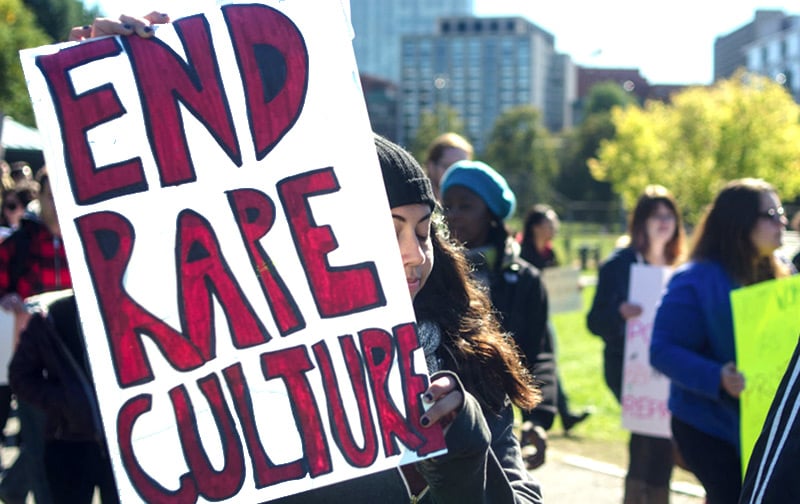
Image result for rape culture

The alarming shift to the right in polities across the world has opened up a crack where toxic man's confidence grows like black mould in the dank locker room at the end of the world. Emboldened by irresponsible hate speech and rape speech, by the utterances of men in positions of power, the lecherous mob has seen fit to step into the light. The largely white masculine TV news media (especially in the US) will not sufficiently condemn it. They have helped create it, after all.

It is not and never has been manly to lord a superiority complex over women and in fact bespeaks cowardice, want of feeling, brainlessness and a deeply warped view of the world. Men who embrace sexual predation, the objectification of women's bodies, and the diminution of women's minds, are not worthy of a place in our societies, let alone a place of leadership. They are not powerful, but they are dangerous. Their credo is violence. When they brazenly occupy not only the social ether but also the streets, becoming a tangible physical and sexual threat, they deserve more than our contempt and condemnation. Step up! If you see something, intervene. Don't stand idly by. Call the police. Now is not the time to be a mouse.

October 04, 2015

The Botticelli Renaissance

Botticelli died and was forgotten. Or so the story goes. Rediscovered in a substantial way by the Pre-Raphaelites, so began a long arc of repetition, quotation and homage, not yet ended. The Gemäldegalerie in Berlin has put together a story of the renaissance of Botticelli, assembling works influenced by the Florentine master. They show the diversity of inspiration found in Botticelli’s brushstrokes, and in particular in the body and beauty of his The Birth of Venus.

I find the long reach of this particular Venus extraordinary. Botticelli’s rendering of Simonetta Vispucci, half floating, half falling out of the half shell, always seemed to me to be an ill-postured, unbalanced, scoliosis affair with a small head. In any case, the Berliners haven’t got their hands on that particular rendition from the Uffizi. They’re making do with a study of the same, isolated against a black ground. I prefer it. Venus, born of nothing, makes much more sense to me than Venus born of a seafood platter. And the version they do have is the highlight of the show, being the only Botticelli actually placed directly into the context of modern works inspired by it.

The fact that some of these works are difficult to look at, and others painfully ridiculous, only draws one back to the original with the thought that genius peaked right off the bat. Rineke Dijkstra’s photographs of beached teenagers, looking for all the world like non-consentingly sexualised bully victims, stand either side of Venus, begging inappropriate questions of pubescent sexuality and nascent womenhood, forcing one to don blinkers and look all the more carefully at Botticelli’s increasingly compelling masterpiece. This is the true stroke of curatorial brilliance. The juxtaposition confronts the eye and demands we reject it, yet the trinity thus presented haunts us with the corruptibility of artistic intention and slaps us with our own corruption.

The rest of the show is anti-climactic, from the pointed photographic dross of David Lachappelle to the Pre-Raphaelite Brotherhood’s own insipid obsession with square jaws and arachnid fingers. The main problem is the striking absence of Botticelli himself, save for the introductory Venus. The modern borrowings suffer for the lack of a narrative. After the striking first impression, this is more of an exercise in artistic genealogy, but with the viewer left to draw the family connections.

Botticelli’s works are, inexplicably, relegated to the rear of the exhibition, lumped together with a number of studio productions of dubious quality. The cursory curatorial narrative slips here, from one of inspiration to apology. Why not spare us half a dozen replications of a single image, each a bit more ropey than the last, in favour of contextualising Botticelli among his adoring followers. By the end, the striking first impression is utterly lost, as are we as we try to find our way to the exit.

March 08, 2011

In Praise of the Egg

It is International Women’s Day. And Pancake Day! Rarely is one’s focus so tightly concentrated on the symbol of the ovum. It may seem difficult to celebrate the achievements of half the global population, but I suggest targeting your attention on the wonders of those women around you. I am blessed to be accompanied daily by women of exceptional intelligence and impeccable taste, and I salute them. To she who is most exceptional of all, I made a votive offering of my own famous pancakes. She is ascending to new heights of brilliance of late, and I count myself especially thankful for her, and for the opportunities that have been freely available to her. Onward!

Rembrandt, The Pancake Woman

March 08, 2010

To Some Women

For your poise, elegance and grace; for your indefatigability in the face of repression; for your sober reasoning; for your compassion, sympathy and spirit; for your independence; for your knowledge of when to be demure, and when to be defiant; for your infinite complexity – trusting that you will recognise yourself among those included hereby – I salute you!

Whatever International Women’s Day means, and I cannot seem to find an acceptable harmony of approach between those nations that celebrate it, I trust that you will make the best of it.

February 05, 2010

The Manly Mind; or, Sex on the Brain

Forgive me for presuming to thrust upon you some thoughts on an ongoing academic project of mine. I have mounted the task of revisiting the Victorian debate on the inherent sexual nature of the brain. I am not seeking to proselytise – far be it from me to assume the Missionary position – but simply to enlighten. Historiographical orthodoxies present themselves to be undressed, and it would be unmanly of me not to oblige them.

The Victorians were under the impression that women ought not to be educated for three simple reasons. First, female brains were thought to be universally smaller then male ones, based on some rather skewed statistical evidence. The brains of leading male intellects who died with healthy heads were compared to a motley collection of female brains pulled from the bodies of the insane, the infirm, and the indecent. Second, nature had fitted women to be the bearers of the stock of human instincts that were manifested in civilization, and it was a female duty, if not a privilege, to pass these on to the future of the race. In short, women were to be mothers. Third, this repository of human evolution was necessarily limited: women were presumed incapable of abstract or original thought; they were incapable, physiologically, of leading politically, artistically, technologically or philosophically. Those cognitive abilities were the preserve of men, who would in turn pass on their bold developments, stored up as newly acquired characteristics of the stock of human evolution in the next generation of mothers. The female mind was conservative; the manly mind was dynamic. The over-education of women was therefore useless, but moreover it risked damaging or distracting from their primary maternal purpose. All this was enshrined in Darwinian or neo-Lamarckian science, and as such has been justly called to book by feminist historians.


So far so good, but the story begs a question. If genuine worldly accomplishments were the sole remit of the manly mind, what did that say for the majority of men who in every respect failed to contribute any philosophical, artistic or technological advances, and who in most respects blindly followed, or ignored, their political leaders? On this, Victorian science had a lot less to say. With a total disregard for critical reasoning, scientists talked of the male and female mind as if all men were of the type of Socrates, Michelangelo, Brunel, or Pericles; as if all women were mere damsels in distress. If anyone had bothered to point this out, it would have been clear that the scientists’ portrayal of the gendered brain was practically worthless, for they surely would not have agreed that manliness was available only to the remarkable, only to the exceptional, only to genius. It cut against the grain of the majority of vernacular thinking on the meaning and definition of manliness, and yet it was held up by the new priesthood as the new law; or rather, the oldest law: that of nature.

We can rest assured, however, that if the Victorians were wrong about sex in the brain, they nevertheless had sex on the brain. Darwin himself was pushing fifty when he and Emma had their last child. The fact that nobody talked about it only added to its excitement. As I’ve said before, being buttoned-up only adds vigour to the unbuttoning.

February 03, 2010

Keep Your Trousers On, Ladies!

A little while ago, Rose C’est La Vie made mention on this site of her interest in female masculinity, and lamented the demise of trousers’ significance as symbols of feminine defiance. One of the lamentable things about throwing out all the rules is that it becomes much more difficult to act subversively. Absolute freedom might, so it seems, come at the price of being dull.

I’m not actually sure I buy that last thought, for complacency is the biggest risk to the freedoms attained. We must remain vigilant. Last night I saw some BBC News footage from Banda Aceh about the stiffening of Sharia Law in that unfortunate place. It is a story of gendered segregation, invidious policing, and a slew of strictures that prescribe what it is moral and immoral to wear. Naturally, the BBC took a left-leaning – or should that be Occidental – perspective, and sought out those brave womanly souls refusing to don headscarves, who cling desperately to long pants. Indeed, the new clamp down includes a ban on women wearing tight trousers. A bewildered trouser seller exclaimed: ‘what we wear doesn’t reflect our morality’. No, but in that setting trousers remain politically dangerous.


We are not given to think about these things any more, but that is a sign of how far we have come in the West. It is worth reminding ourselves from time to time that the matter-of-fact ubiquity of women in ‘men’s clothing’ is an emblem of our liberality. These things are matter-of-fact only after significant struggle; they represent other struggles of greater weight, about which we are also now dangerously blasé. Indeed, trouser wearing is the thin end of the wedge. That is precisely what the Aceh authorities are afraid of. And it is precisely why we should not cease to celebrate the history embodied by all women who don their slacks without a second thought.
Related Posts with Thumbnails